GUIDE
Bridges Are Custodians Too: Reading a Cross-Chain Bridge Through the Custody Question
Crypto Bank Editorial Team · November 18, 2026
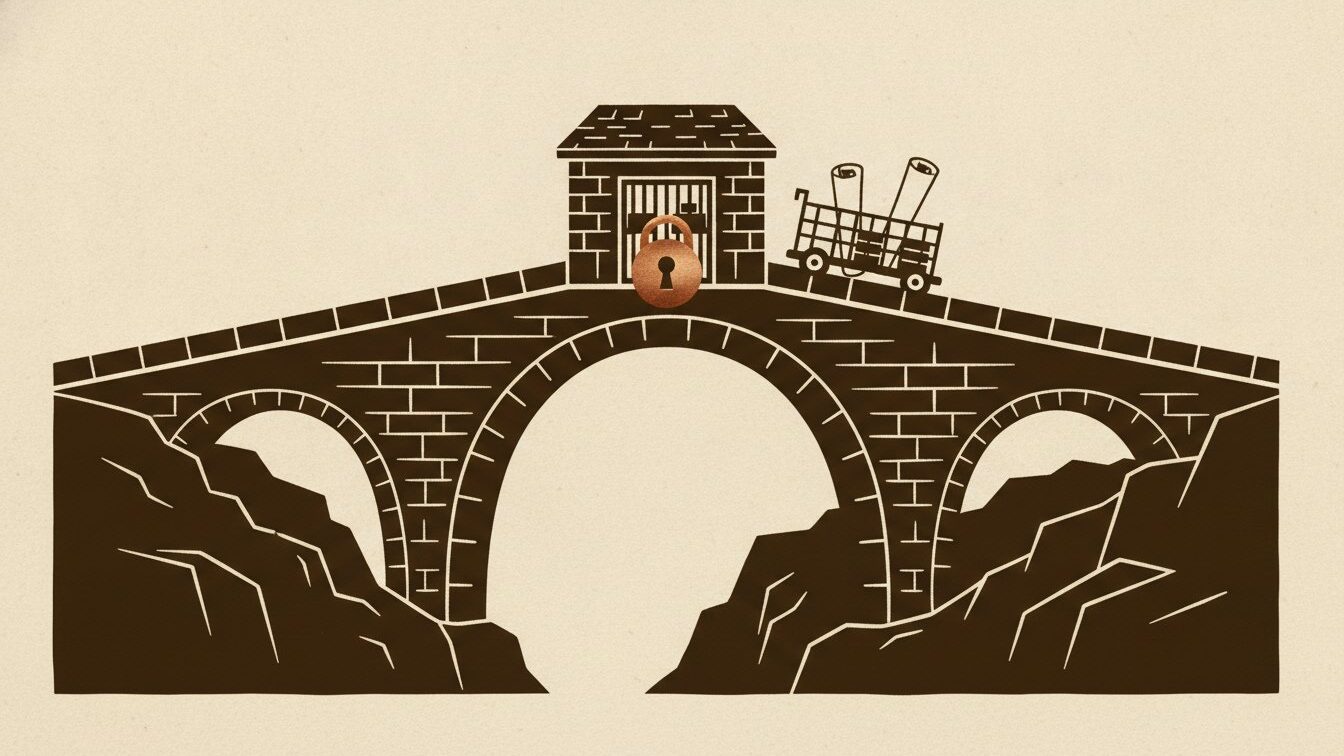
Blockchains cannot read each other’s records. To move value from one network to another, something in the middle has to hold the original asset and vouch for a representation of it elsewhere. That something is a bridge, and despite the engineering language around it, it does exactly what a custodian does: it holds other people’s assets and issues them a claim. The Custody Question applies to it as directly as to any trust company.
How a bridge holds your asset
In the common lock-and-mint design, you deposit an asset into a bridge contract or address on the first network, where it is locked. The bridge then issues a token on the second network that is meant to be redeemable for the locked original. To go back, you return the token and the original is released. The token you hold is not the asset; it is a claim on a vault, and its value depends entirely on the vault being intact and the release process being honoured.
Why bridges are targets
A bridge concentrates large amounts of locked value in one place, and it must correctly verify events on one chain before acting on another, using machinery that is complex and comparatively young. Concentrated value plus complexity is what attackers look for. When a bridge vault is drained, the representations on the other network can become unbacked overnight: still visible in wallets, no longer redeemable.
Who controls the vault
Many bridges release locked assets when a set of validators or signers approves, for example a majority of a published signer set. That looks like multisig-style protection. The questions that decide whether it is real are the same ones we ask of any custodian’s signing scheme:
- How many of the signers are independent? If several keys are held by one organisation, or one party has been allowed to sign on another’s behalf, the effective threshold may be a single organisation. Delegations granted for convenience and never revoked are a known failure pattern.
- Where do the keys live? Keys on internet-connected infrastructure share that infrastructure’s weaknesses. See why the signing path is the custody risk.
- Can the code be changed, and by whom? Upgradeable contracts mean an administrator key is also a control point.
- Is anyone watching? A vault with no alerting on large or anomalous withdrawals, and no routine reconciliation between locked collateral and the tokens issued against it, can be emptied without anyone noticing for days. Reconciliation is a basic custody control; see custody plumbing.
Insurance and default
Bridges rarely carry anything resembling the crime or specie insurance that some custodians disclose. If the vault is drained, there is usually no legal entity with a custody agreement, no regulator acting as receiver and no defined insolvency process: holders of the wrapped token are left with whatever the project, its backers or a negotiated recovery can offer. That is a materially weaker position than even an unsecured creditor of a regulated custodian, because there may be no estate at all.
In practice
- If you need an asset on a particular network, buying it natively there, or moving it through a platform that handles the transfer internally, often avoids a bridge entirely. You then face that platform’s custody terms instead; see three questions for any platform.
- If you do bridge, prefer designs whose signer set and upgrade powers are published and independently reviewed, move modest amounts, and do not leave value sitting in a wrapped form longer than you need.
- Check the destination network carefully. Bridging is one of the easiest places to send to an address on the wrong chain, and that error cannot be undone.
- Institutions holding wrapped assets should treat the bridge as a sub-custodian in their own risk review: name it, document its control points and set exposure limits. See the hidden chain of custody.
The Custody Question, applied
- Who holds the keys: the bridge’s signer or validator set, plus whoever can upgrade the contracts. Count the independent parties, not the keys.
- Who insures it: usually nobody.
- What happens on default: often no legal process at all; the wrapped token can become unredeemable.
This explainer describes a design pattern and does not assess any specific bridge. Not financial advice. Crypto Bank is not a bank and does not hold client assets.