GUIDE
Cold, Warm and Hot Storage: The Custody Risk Trade-Offs
Crypto Bank Editorial Team · November 17, 2026
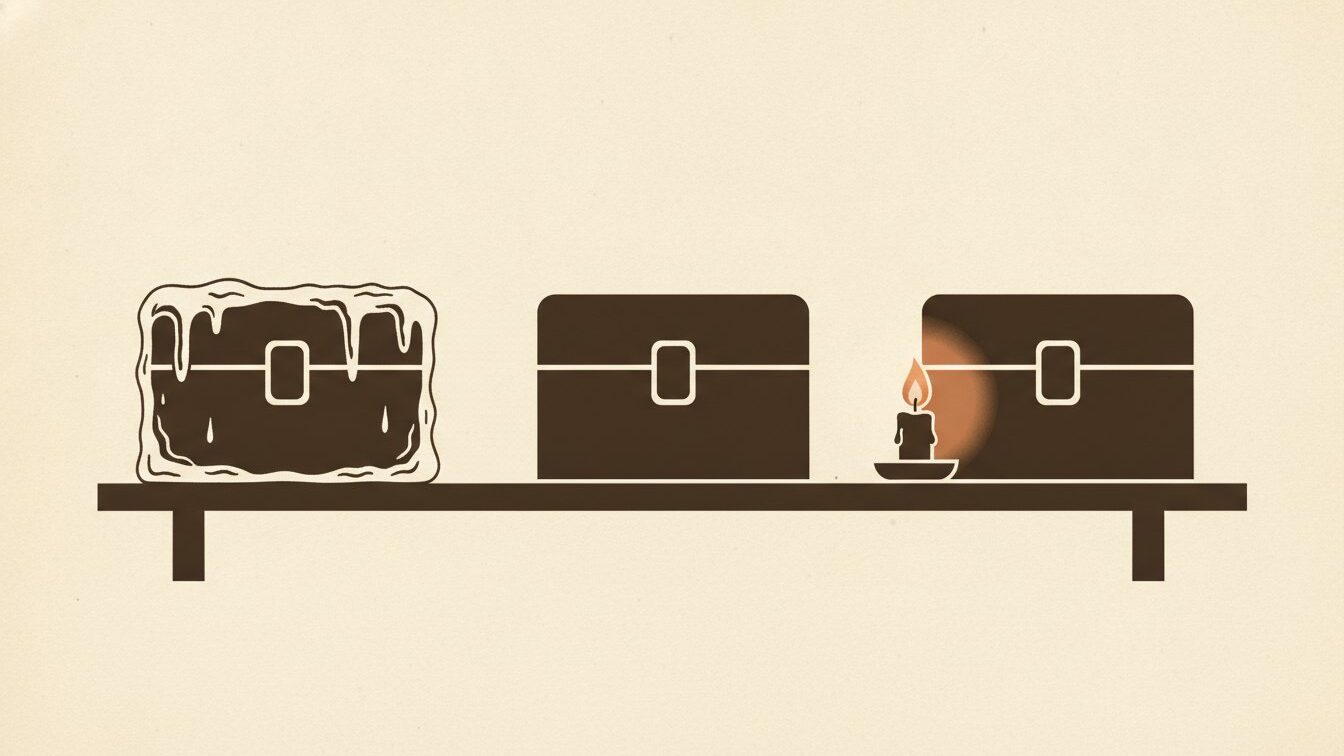
Cold, warm and hot storage describe how close a private key sits to a live internet connection, and that distance is the single biggest lever determining how exposed a balance is to remote theft — and how quickly it can actually be moved when someone legitimately needs to move it. Every custodian makes a trade-off here, and “we use cold storage” by itself does not say where on that trade-off a given balance actually sits.
These three words show up constantly in custody marketing, usually without much further detail, which is itself worth noticing: the tier a provider chose is a genuine, meaningful design decision, and a provider confident in that decision generally has little reason to avoid describing it with some specificity.
Hot storage
A hot wallet’s keys are held on a system that is connected to the internet and able to sign transactions automatically or near-automatically, without a human manually retrieving an offline key for each transaction. This is what makes same-day withdrawals, trading, and automated operations possible. It is also the most exposed tier: a system connected to the internet is a system that can, in principle, be reached remotely, and the large majority of publicly reported exchange hacks have involved hot-wallet compromise rather than a physical breach of an offline vault.
Custodians generally keep only a limited operational float in hot storage — enough to cover expected withdrawal volume — specifically because of this exposure, moving the remainder to warmer or cold tiers. How large that float is, and how it is secured beyond “it’s connected to the internet,” is a meaningful operational detail that is rarely disclosed in any standardized way.
Warm storage
Warm storage sits between the two extremes: keys are not permanently online the way a hot wallet’s are, but moving funds does not require the fully manual, offline process cold storage does either. Implementations vary a lot under this label — it might mean keys held in a hardware security module that requires a human approval step but no physical travel, or a semi-automated process with time-delayed or multi-step authorization. Because “warm” is not a standardized term the way “hot” and “cold” have more settled common meanings, it is one of the custody words most worth asking a provider to define specifically rather than accepting at face value.
Cold storage
Cold storage means the signing key is kept entirely offline — on a device, or split across devices and locations, that is never connected to the internet during normal operation. Moving funds out of cold storage typically requires a deliberate, manual process: physically accessing hardware, often in a secured facility, sometimes requiring multiple authorized people to be present (a procedure sometimes described as requiring dual control or multiple custodians of a physical key or device). This is the slowest tier to move funds out of, by design — the friction is the security feature, not a flaw. A thief who compromises a custodian’s networks gains nothing from that compromise alone if the bulk of assets sit in a cold system with no network path to it at all.
Cold storage is not risk-free. It shifts the risk profile rather than eliminating it: physical theft, loss or destruction of the hardware, a natural disaster affecting a single physical site, or an insider with legitimate physical access acting dishonestly all become the live concerns, replacing remote network intrusion as the main threat model.
There is also a real liquidity cost to cold storage that is easy to underweight when “more cold storage is safer” is treated as an unconditional rule. A custodian that is slow to access its own cold reserves during a period of unusually high legitimate withdrawal demand can find itself unable to meet client requests promptly even while fully solvent and fully in control of the underlying assets — a liquidity problem that looks, from a client’s side, uncomfortably similar to the early stages of a more serious problem, even when it is not one.
The actual trade-off: speed versus exposure
None of the three tiers is “the secure one” and the others “the insecure ones.” Every custodian needs some hot capacity to function as a business at all, and a custodian with 100 percent of assets in cold storage would be unable to process a withdrawal without a manual, multi-day process every time — impractical for most use cases, including ones where client assets are needed quickly. The real question a reader should be asking is not “does this provider use cold storage” (nearly all claim to, for at least part of their holdings) but what percentage of total client assets sits in each tier, and whether that allocation is disclosed at all.
Operational practices worth asking about, beyond the label
- Geographic distribution. Splitting cold-storage key material or hardware across multiple physical sites reduces the risk that a single site’s disaster, seizure, or compromised staff member can affect the entire cold balance. A custodian that concentrates everything in one location has a different risk profile from one that distributes it, even with an identical “cold storage” label.
- Air-gapped key generation. Some custodians generate cold keys on hardware that has never been connected to any network at any point, including during generation, reducing the chance that key material was ever exposed even momentarily. Others generate keys on networked hardware and move them offline afterward — a meaningfully different, generally weaker, guarantee.
- Who has physical access, and under what control. A dual-control requirement (two or more specific, authorized individuals needed to access a cold storage site or device) is a different assurance from a single employee or officer having unilateral physical access.
- How withdrawals from cold storage are authorized internally. A documented, multi-person sign-off process is a different thing from an informal practice that depends on which staff happen to be available that day.
The disclosure gap
Very few providers publish a specific breakdown of what share of client assets sits in hot versus warm versus cold storage at a given time, and the ones that do rarely commit to keeping that breakdown current. This is a meaningful gap: a provider holding 95 percent of assets in cold storage and 5 percent in a well-monitored hot wallet has a very different exposure profile from one running the reverse ratio, and the word “we use cold storage” is consistent with either. Where a provider has published a specific, dated breakdown, we note it on the relevant custody profile; where none exists, that is recorded as a gap rather than assumed to be favorable or unfavorable.
Where this fits the Custody Question
Storage tier is part of the first row of the Custody Question we run on every provider profile — who holds the keys — but it is not the whole answer. A custodian can hold keys entirely in cold storage and still fail the broader question if those keys are not meaningfully segregated per client (see our segregation guide), or if a single individual has unsupervised physical access to the cold storage site. Storage tier addresses network exposure specifically, not every form of risk.
FAQ
- Is cold storage immune to hacking?
- It is immune to the specific category of remote network intrusion that affects internet-connected systems, because there is no network path to reach it during normal operation. It is not immune to physical theft, insider misuse during the manual access process, or loss of the hardware itself.
- How fast can a custodian move funds out of cold storage if a client needs them urgently?
- This varies by provider and is usually measured in hours to a few business days rather than instantly, precisely because the manual, multi-person process is the point of the security model. A provider’s specific service-level commitment on withdrawal timing is worth asking about directly, and worth comparing against its disclosed hot-wallet float, since a provider promising instant withdrawals from predominantly cold-stored assets is implicitly describing a float large enough to cover that promise, or a process faster than the manual model this guide describes.
- Does “multi-signature cold storage” combine both protections?
- Yes — it is common for cold-stored keys to also be split under a multisig or MPC scheme (see our multisig vs. MPC guide), meaning both network isolation and multi-party authorization apply at once. This is generally a stronger combination than either protection alone, though it adds operational complexity.
- Does warm storage add real security, or is it mostly marketing?
- It can add real security when it involves genuine additional authorization steps (hardware security modules, time delays, required sign-offs) beyond what a hot wallet has. Because the term is not standardized, the same word can also be applied to a setup that is functionally closer to a hot wallet with an extra label — asking the provider to describe the actual mechanism, rather than relying on the tier name, is the only way to tell which is the case.
Risk note
Storage-tier allocation and the specific procedures around it vary by provider, are often undisclosed, and can change without public notice. Nothing here describes any specific provider’s current practice.
Not a bank. Not a deposit-taking institution. No FDIC, FSCS or deposit-insurance cover. Editorial only.
Not financial advice.